


In the manufacture and maintenance of high-temperature industrial equipment, refractory castables play an important role. As one of the important types, low-cement refractory castables are widely used in various high-temperature environments due to their unique performance characteristics. Introduce the basic properties of three different low cement castables in order to better understand and apply these materials.
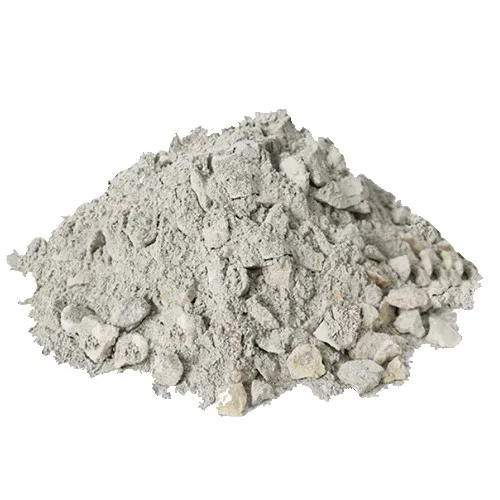
1. Alumina-silicate low-cement refractory castables
Alumina-silicate low-cement refractory castables are made of alumina-silicate refractory materials as the main raw materials. They are made by adding appropriate amounts of low-cement binders, refractory aggregates and refractory powders, etc., and are made through mixing, stirring, molding, and curing processes. This castable has excellent high-temperature resistance, and its refractoriness can reach above 1790 degree , and it can maintain stable performance for a long time in high-temperature environments. In addition, alumina-silicate low-cement refractory castables also have good thermal shock resistance, which can resist thermal expansion and contraction in high-temperature equipment, thereby increasing the service life of the equipment.
In terms of physical properties, aluminum silicate low cement refractory castables have high compressive strength and flexural strength. With the increase of heating temperature, its strength increases significantly, and the strength at 1500 degree is about twice the drying strength. In addition, the flexural strength of the castable at a high temperature of 1400 degree can reach 1.5~2.3MPa, which is nearly twice as high as the traditional CA-50 cement refractory castable. This excellent mechanical property makes aluminum silicate low cement refractory castables have a wide range of application prospects in high-temperature industrial equipment.
In terms of thermal expansion performance, aluminum silicate low cement castables show expansion characteristics throughout the heating process. With the increase of heating temperature, the thermal expansion rate gradually increases, reaching a maximum value of about {{0}}.68% at 1250 degree . After that, it begins to shrink slowly, with a thermal expansion rate of 0.43% at 1400 degree , and when the temperature is 1500 degree , the thermal expansion rate rises back to 0.5%. This moderate thermal expansion rate helps to reduce stress concentration and cracking caused by temperature changes, thereby improving the refractoriness and thermal shock resistance of the castable.
2. High-aluminum low-cement refractory castable
High-aluminum low-cement refractory castables are made of high-aluminum refractory materials as the main raw materials, and are also made by adding appropriate amounts of low-cement binders, refractory aggregates and refractory powders. This castable has high refractoriness and thermal shock resistance, and can maintain stable performance in extremely high temperature environments.
In terms of physical properties, high-aluminum low-cement refractory castables also have high compressive strength and flexural strength. Its strength increases significantly with the increase of heating temperature, especially in the medium temperature range, showing a more significant strengthening effect. In addition, the castable also has good wear resistance and erosion resistance, and can maintain stable performance for a long time in harsh environments such as high-temperature fluid erosion and mechanical wear.
In terms of thermal expansion performance, high-aluminum low-cement refractory castables also show expansion characteristics. However, compared with aluminum silicate castables, its thermal expansion rate is smaller and the changes are more stable. This stable thermal expansion performance helps to reduce the volume change and stress concentration of the castable at high temperature, thereby improving its refractoriness and service life.
3. Alumina low-cement refractory castable
Alumina low-cement refractory castable is made of alumina as the main raw material and has extremely high refractoriness and excellent thermal shock resistance. This castable can maintain stable performance for a long time in extremely high temperature environments and is one of the indispensable materials in high-temperature industrial equipment.
In terms of physical properties, alumina low cement castables have extremely high compressive strength and flexural strength. Its strength increases significantly with the increase of heating temperature, especially in high temperature areas, showing a more significant strengthening effect. In addition, the castable also has excellent properties such as good wear resistance and anti-scouring performance, as well as low thermal conductivity and linear expansion coefficient.
In terms of thermal expansion performance, alumina low-cement refractory castable also shows expansion characteristics, but the thermal expansion rate is smaller and the change is more stable. This stable thermal expansion performance helps to reduce the volume change and stress concentration of the castable at high temperature, thereby improving its refractoriness and service life.
The three different low-cement refractory castables have their own characteristics and show excellent performance characteristics in high temperature resistance, thermal shock resistance, physical properties and thermal expansion performance. In practical applications, the appropriate type of castable should be selected according to the specific use environment and requirements to ensure the normal operation of the equipment and extend its service life.


